The Two Faces of August
August is one of my favourite months at the food bank, and one of the hardest. Both things are true at the same time, and most years I still don’t know what to do with that.
Here’s the favourite part first. August is harvest season, and our produce shelves are about as full and beautiful as they ever get. Wilmot Orchards, Gibson Farms, and Kent Farms keep us stocked with fresh fruits and vegetables, and community gardens like the Wilmot Creek Garden Club and Jury Lands add even more to the table. Our neighbours light up when they see it. Honestly, so do we. There’s something about handing someone a bag of fresh tomatoes or sweet corn instead of another can that just feels different, it feels like more than food. Fresh produce is one of the few genuine wins we get to hand out on a regular basis, and we don’t get nearly enough of those.
August also means more kids around the food bank, which comes with its own kind of full-circle moment I never get tired of. We’ve watched some of our summer students grow up right in front of us. Kids who used to come through the door as babies, then toddlers, then shy kindergarteners holding a parent’s hand, and now they’re back as teenagers, volunteering their summer to help us do this work. Seeing that happen, watching someone go from being helped by us to helping run it, is one of the best parts of the job. It reminds you why any of this matters.
Now the hard part.
By the end of summer, I can walk into our warehouse and tell you almost exactly how many cans of anything we have left, because there usually aren’t many. Canned corn, canned peas, kidney beans, the basics that make up so much of what a household actually cooks with, start running thin, and some weeks they run out completely. It’s a strange kind of quiet down there in August. Rows of shelving that are usually stacked are just… rows.
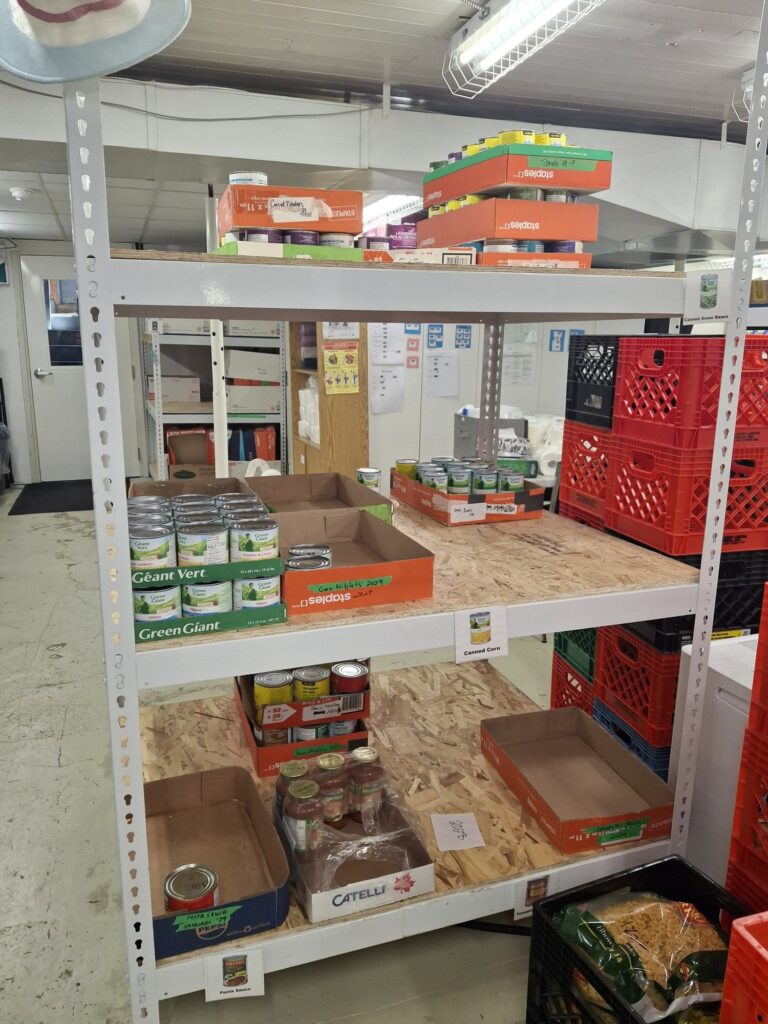
This is what our shelves look like by the end of a summer. What you’re not seeing is the rest of the room — mostly empty too.
We’re fortunate that this community’s financial donations let us go out and buy what we’re missing. But that raises its own hard question, one I find myself sitting with more than people probably realize: how do you decide what to prioritize with donation dollars that never stretch quite as far as you’d like? Toothpaste and toilet paper are necessities in every single household; nobody chooses to go without those. But so is having actual food on the shelf, the canned corn, the kidney beans, the peanut butter that a family is counting on. And then there are the smaller things, the pudding cups, the crackers, the little bit of “extra” that doesn’t keep anyone alive but makes a shopping trip feel less like a transaction and more like someone was thought of. None of it feels optional when you’re the one deciding, and none of it feels like enough.
This is why I want to be honest about something: your donation dollars do their heaviest lifting in August. Right now, this month, what you give goes further than almost any other time of year. We’ve just used recent donations to purchase non-perishable food that will help keep our doors open for the next three months — food that has to carry us until fall food drives start refilling the shelves and the community’s attention naturally turns toward the giving season.
Hunger doesn’t take the summer off, even when the rest of the world seems to. The produce tables are full right now, and I hope you can feel good about that, because it’s a genuinely good thing. But underneath that, the shelves that carry us through the rest of the year need help too, quietly, in a month when most people aren’t thinking about food banks at all.
If you’ve got a little to give this August, know that it’s not going to sit in a drawer waiting for December. It’s going straight onto a shelf that needs it right now.
Thank you for seeing both sides of this month with us.
Susan